Project & Award: This team project (Dongjae Kim, Nakyung Kim, Yena Cho, Gaeun Kim) was awarded the Excellence Award at the 2022 Pukyong National University Data Analysis Competition.
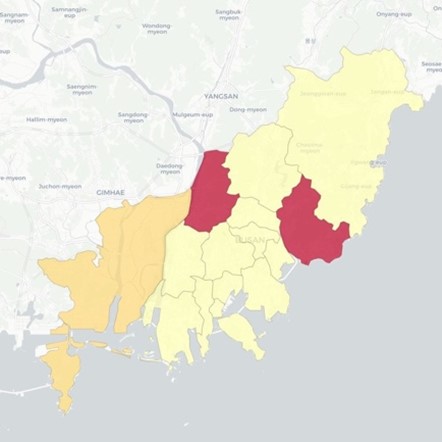
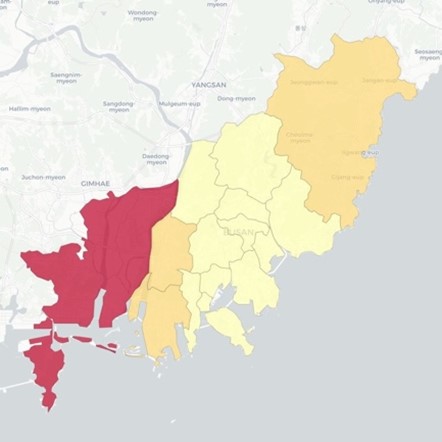
Figure 1. Visualization of Human Risk Factors (Left) vs. Physical Risk Factors (Right)
Effective urban planning and resource allocation require precise, data-driven decision-making. This project aimed to analyze and select highly vulnerable fire-prone areas in Busan—specifically focusing on Gangseo-gu—to optimize the deployment of limited fire response infrastructure.
📌 The Problem: Complex Human and Physical Risk Factors
Busan ranks exceptionally high in both total fire incidents and fire incidents per capita among major cities in South Korea. Urban fire risks are not one-dimensional; they are driven by a complex interplay of human factors (e.g., vulnerable demographics, energy usage) and physical factors (e.g., aged buildings, hazardous facilities). Deploying fire response resources uniformly is highly inefficient. A data-driven approach was needed to pinpoint the exact administrative districts where the risk is highest but response capabilities are lowest.
⚙️ The Method: Sparse PCA and Ensemble Clustering
To quantify and map these vulnerabilities, we developed a comprehensive data analytics pipeline:
- Feature Engineering: Collected and preprocessed 17 distinct variables across Busan’s districts. These were categorized into ‘Human Factors’ (population density, smoking rates, vulnerable populations) and ‘Physical Factors’ (aged building count, fire hazardous facilities, lack of fire stations and water facilities).
- Dimensionality Reduction (Sparse PCA): Applied Sparse PCA to effectively reduce the dimensionality of the features into a 2D plane (Human vs. Physical) while maintaining strong explanatory power and interpretability without being sensitive to outliers.
- Machine Learning Clustering: Deployed multiple clustering algorithms, including K-Means, Affinity Propagation, and Gaussian Mixture Models (GMM). Through optimal cluster evaluation (Elbow Method, Silhouette Score), the system successfully identified Gangseo-gu as the most severe fire-vulnerable cluster.
🚀 The Impact: Tailored Urban Decision-Making
We further analyzed the top 5 vulnerable neighborhoods (dongs) within Gangseo-gu and categorized them into three specific management zones:
- Fire Target Concentration Zone
- Fire Hazard Building Warning Zone
- Firefighting Power Expansion Zone
Based on this categorization, the team proposed actionable, localized urban policies. These included the mandatory expansion of advanced non-combustible insulation (PF boards) for aged areas, and the introduction of high-tech response systems like Unmanned Firefighting Drones and AI Fire Detection Systems to overcome the physical distance to fire stations.